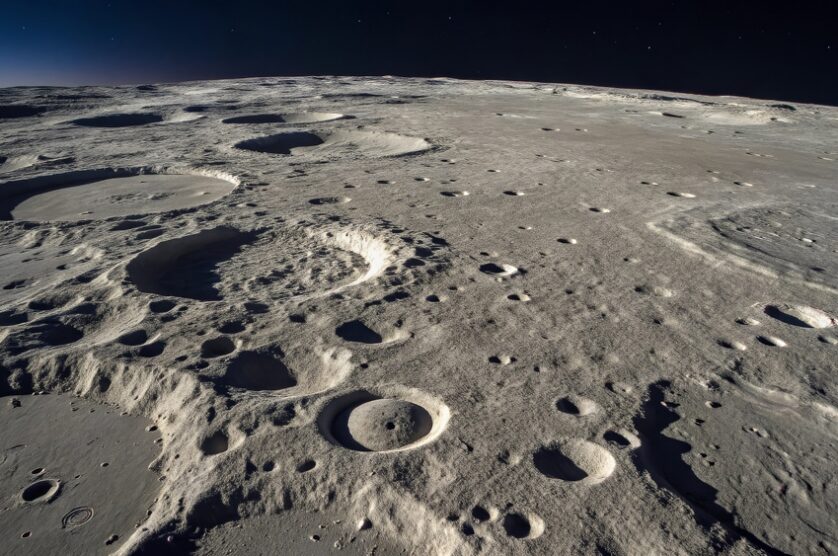
I spend my working life on a narrow question. Who owns this piece of ground, and can we prove it. It is not a glamorous question. Most days the answer is boring, and boring is the product. So I did not expect to think as much as I have recently about the Moon.
It started at a dinner. Someone asked, half joking, who would insure ownership and non-distruption to a building on the Moon once somebody puts one there. I laughed, and then I could not let it go, because the honest answer runs straight through everything I do for a living.
My piece on it just ran on Inc., “The Ground Nobody Owns”. This is the longer version of how I got there, including a few things that did not make the final cut.
The frontier is not lawless. It is missing one specific thing.
Most people assume space is a legal void. It is not. Starting in the late 1960s, the world negotiated a whole body of space law. If you launch an object, you keep it. The nation that registered it keeps legal authority over it. There is a United Nations registry of what has been launched. If your satellite hits mine, your government is on the hook. There are even coordination zones, under the newer Artemis Accords, that operators agree to steer around.
Read that list as a title attorney and one absence jumps out. We have personal property, jurisdiction, a recording system, and liability. We built the entire scaffolding that normally surrounds land ownership. We just never put land ownership in the middle of it. The 1967 Outer Space Treaty bars any nation from claiming a celestial body, so no government can own lunar ground, which means no government can hand out ordinary title to it. The center was left deliberately empty.
For sixty years that emptiness cost nothing, because nobody could reach the ground to care. That is the part that is now about to change.
The pressure is not curiosity. It is supply. The refined rare earth elements behind magnets, motors, electronics, and defense systems come largely from a single country, and the United States is spending real money to change that. It turns out the Moon holds material rich in those same elements, and we have a rough map of where. Whether it ever makes economic sense to mine is genuinely unsettled and probably years away. But the strategic logic does not wait for the spreadsheet. Nobody claims worthless ground. The moment the ground holds something you cannot get elsewhere, the claiming begins.
Here is the parallel I keep coming back to, one a reader raised after the article ran. The deep seabed in international waters holds critical minerals, and nobody owns it. There is an international body meant to govern extraction there. Decades in, it still has not agreed on commercial mining rules. So companies have started routing around it, applying under the national law of a country that never joined the treaty in the first place.
That is the whole pattern in miniature. The shared framework moves slowly. Capital does not wait. And enforcement ends up flowing through whichever government is willing to stand behind the claim. The Moon simply raises the stakes.
Strip away the science fiction and the question becomes familiar. Title insurance works on Earth and more specifically the United States for one reason: when a claim goes wrong, there is a sovereign and a court that will enforce the outcome. A policy is a promise about what a government will do with its monopoly on force. Remove the government and the promise has nothing beneath it. You can insure the rocket. You can insure the equipment. You cannot insure the ground, because ownership was never really the paperwork. It was always the enforcement standing behind the paperwork.
So when the first company builds a base or a refinery up there and needs to protect the investment, no lawyer can hand it a clean title. Not yet. What will happen instead is what has always happened. Someone will build, stay, and become too established to remove. The paperwork will arrive years later to formalize what presence already settled. Title has always been the last thing to arrive, not the first. We just do not usually get to watch it happen from the beginning.
If you want to know when the era has truly turned, do not watch for a treaty or a headline. Watch for the first real protection an institution is willing to stand behind over lunar ground, an insurance policy, a government guarantee, a carve-out of some kind. On the day that document exists, the treaties will still say no nation owns the Moon. The document will quietly tell you that a company built something valuable enough to pull a government in behind it.
It will be the least dramatic paperwork imaginable. And it will mark the moment the Moon stopped belonging to everyone.